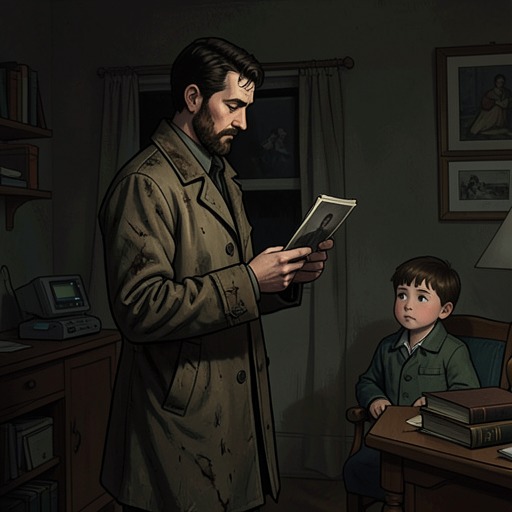
Lionel Essrog and Frank Minna’s mentor–student bond
Motherless BrooklynLionel Essrog and Frank Minna’s mentor–student bond grows from a chance rescue into a formative apprenticeship: Frank Minna gives Lionel work, attention, and a way to use the language that had made him an outsider. The bond is generous but not simple. Frank recognizes Lionel’s difference and draws him into the adult world, yet he also turns that difference into an effect for clients and associates. The relationship teaches Lionel both how to observe and how to speak, while leaving open the cost of being valued partly for unsettling other people.
Origins in the Home
Before Frank appears, Lionel is searching for a language in which to understand himself. At St. Vincent’s Home for Boys, books and television offer no convincing model; the narrator recalls that it was Frank and Court Street who finally let Lionel speak. Their connection begins against that background of isolation, not with a formal offer of care but with an abrupt departure from the Home.
A teacher, Mr. Kassel, knew Frank from the neighborhood and invited him to borrow four boys for an afternoon. The selection was shaped by race: Frank wanted white boys to suit what he presumed were his clients’ prejudices, as well as his own. Lionel remembers himself as an inferior choice, retrieved from the library rather than the schoolyard, and contrasts the boys’ lack of connections with Frank’s ability to benefit from knowing people. In Frank’s dented van, the boys were shut behind padlocked doors without an explanation or even an exchange of names. For Lionel, however, the unexplained trip also meant escape from the institution’s routine. The bond therefore starts in a mixture of exclusion, uncertainty, and the possibility of being taken up by the outside world.
Recognition and Early Attachment
The boys’ first encounter also sets Frank apart from the authority figures they know. When Tony Vermonte identifies Lionel as a freak, Frank responds by pointing out that all four boys are parentless. The remark does not erase Lionel’s symptoms, but it refuses to isolate him as the only abnormal person in the group. Frank’s response makes room for a shared condition, and it marks an early form of recognition: Lionel is not merely a spectacle to be singled out by his peers.
That recognition is imperfect. Frank had selected the boys partly to serve other people’s prejudices, and he did not explain what he wanted from them. Yet he saw potential in the group, especially in Tony, and imagined that the boys might become the Minna Men. In retrospect, Lionel understands this as an early seed of the organization Frank would build, rather than as a fully declared plan on that first afternoon. Frank’s attention thus carries both instrumental and personal force: the boys are recruited for a purpose, but they are also offered a place in a world from which the Home had kept them apart.
An Apprenticeship in Observation
As the boys begin working for Frank, he assigns them different roles. Gilbert Coney is directed toward physical labor, while Danny Fantl becomes a trusted courier and driver in training. Lionel’s place is less conventional: he is an extra pair of eyes and ears, and, crucially, a source of opinions. Frank brings him to back rooms, offices, and barbershop negotiations, then asks him to assess the people they have encountered. The questions train Lionel to notice character and motive, turning observation into a practical part of the work.
Frank does not simply take Lionel along; he expects him to interpret what he sees. He encourages him to offer judgments, and Lionel describes being drawn into the rhythm of Frank’s overheard conversations, complaints, and arguments. The arrangement gives Lionel a recognized function inside the group. Speech that had previously seemed detached from its surroundings becomes, in Frank’s company, a kind of commentary on them. The apprenticeship is therefore not just exposure to Frank’s errands: it is a lesson in attending to people and making an account of them.
Speech, Difference, and Complicity
Frank’s response to Lionel’s Tourette-related speech is central to the bond. He mistakes Lionel’s echolalia for impressions and enjoys the disruption it causes among clients and associates. When an utterance or head jerk interrupts a conversation, Frank explains it away and treats the interruption as a running joke. He also winks at Lionel, acknowledging a private complicity between them. Lionel understands the arrangement as Frank licensing his speech: the symptoms are not cured, but speaking can briefly relieve the pressure of them.
This acceptance has a double edge. Frank makes Lionel’s speech socially usable and gives him a role where it can matter; at the same time, he enjoys Lionel as a special effect, someone whose difference can unsettle a room. The relationship does not require choosing between those facts. Frank’s amusement and his encouragement coexist, and Lionel’s account stresses how both help shape his experience. The language that had made him conspicuous becomes a form of participation, even as Frank’s framing keeps it partly in the register of entertainment.
Frank’s care also appears in a small, deliberate act of recognition. He gives Lionel a paperback titled Understanding Tourette’s Syndrome, explaining that he had meant to get it to him but had been busy. Lionel had not previously encountered the term. The book supplies a name for what he experiences, while Frank’s gesture shows attention beyond the comic use he makes of Lionel’s symptoms. Coming after years of being treated as an oddity, the gift connects practical recognition with a private attempt to help Lionel understand himself.
Influence and Uneasy Legacy
Lionel learns from Frank in ways that extend beyond work. He watches how Frank behaves with women, studying his teasing and physical familiarity as a model of social conduct that the boys themselves lack. The account presents this as observation rather than instruction: Frank’s manner becomes part of what Lionel and the others absorb while trying to understand adult life. The mentor’s influence reaches into the boys’ ideas of confidence and behavior, not only their emerging trade.
The bond also has limits visible in retrospect. Tony, whom Frank noticed early and treated as a leader, ultimately wanted to inherit Frank’s criminal power and take over his share of the Fujisaki scam. Lionel sees Tony as aspiring to become a more efficient and brutal version of Frank, without the softness that led Frank to gather boys like him. This contrast clarifies what Lionel received from Frank: not simply a model of authority to imitate, but attention, work, and an opening for his own voice. Frank’s mentorship helps make Lionel an observer and participant in the world of the Minna Men, while the difference between Frank’s imperfect generosity and Tony’s ambition keeps the legacy unsettled.